Welcome to the Collection Room
Every museum begins with a collection, and so does every life. The things we gather first are rarely grand or deliberate. They are odd scraps that end up in drawers, on shelves, in boxes tucked under beds. A concert wristband, a hotel soap, a seashell, a button that no longer has a coat. These objects do not make sense to anyone else, but to the person who keeps them, they are anchors. They remind us not just of what happened, but how it felt to be there.
Psychologists call this cue-dependent memory: a small object can bring back an entire scene more vividly than words alone. A ticket stub can conjure the laughter of an evening. A stone can bring back the sound of the sea. Thing theorist Bill Brown writes that we often look through objects until they suddenly catch our attention again – charged with memory, heavy with feeling. It is at that moment, when an object stops being simply useful or ordinary and becomes noticed, remembered, or felt, that it turns into a thing. Anthropologist Daniel Miller notes, “the things we keep are the things that keep us.”
In the Collection Room, objects appear as:
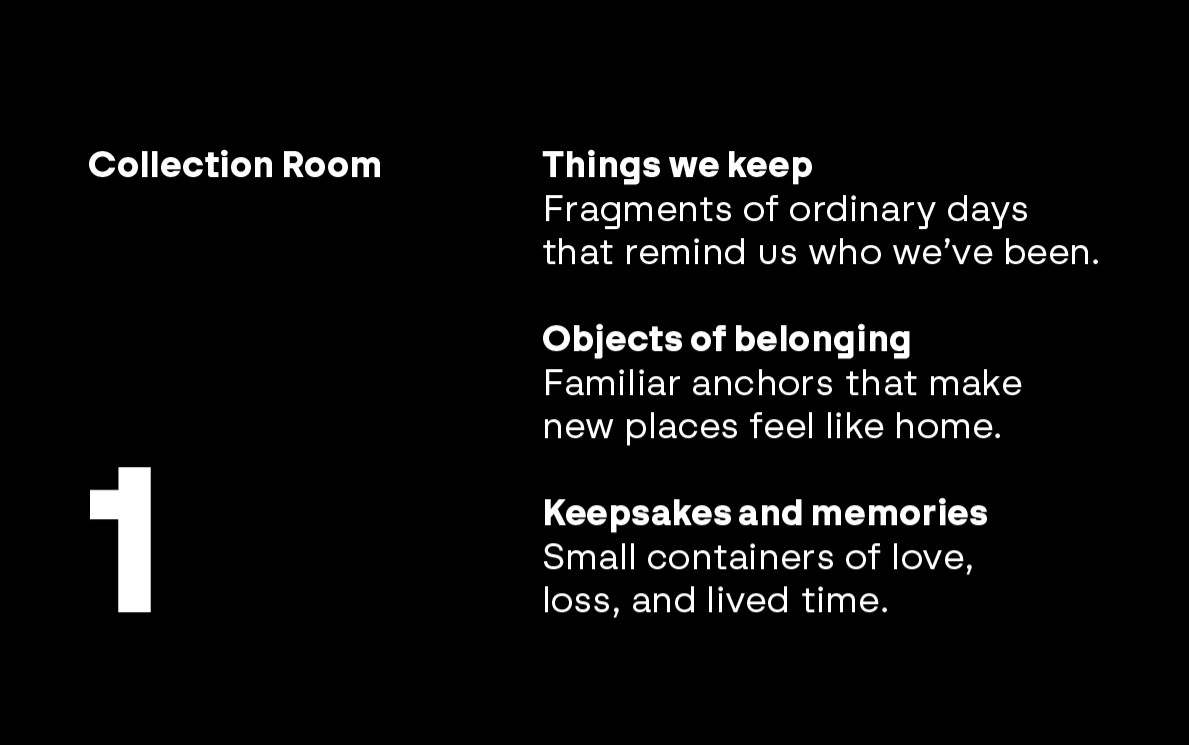
Things we keep – fragments of ordinary days that remind us who we’ve been.
Objects of belonging – familiar anchors that make new places feel like home.
Keepsakes and memories – small containers of love, loss, and lived time.
The thinking behind the room draws on three connected ideas.
First, research in material culture (Daniel Miller) suggests that collecting is one of the ways humans make sense of who they are. We don’t collect to accumulate value, but to externalise identity – to see ourselves reflected in the things we choose to keep.
Second, the idea often described as the memory of objects reminds us that things matter not because of what they are, but because of the stories and emotions we place inside them. Objects become meaningful through personal narrative, quietly holding on to moments that might otherwise fade.
And finally, Thing Theory suggests that most objects remain invisible in our daily lives until one day they stop being ordinary and are suddenly noticed, remembered, or felt. In that moment, an object becomes something more – charged with meaning.
None of these objects are important because of what they are. They matter because of what they carry – and because of what they help us remember about ourselves.
What object do you return to when you want to remember someone, or something, that mattered?
Until next time – notice what you keep, and what keeps you.
If you’d like to explore this together, I’d love to hear from you.
#Memory #Storytelling #Museums #Collecting #Identity #HumanExperience #Learning #Facilitation